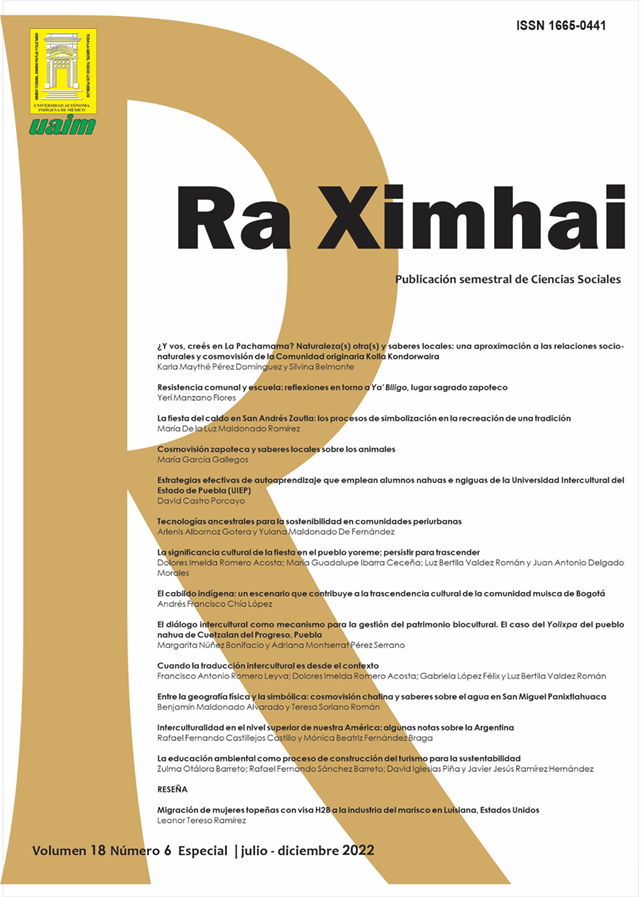
The broth festival in San Andrés Zautla: the processes of symbolization in the recreation of a tradition
DOI:
https://doi.org/10.35197/rx.18.06.2022.03.mmKeywords:
party, popular religion, symbolisms, brotherhood, genderAbstract
This text aims to reflect on the importance of festivals within the religious practices of Indigenous communities, as contexts for social interaction and ritual processes where diverse symbolic processes are articulated, nourishing and conveying the transmission of traditions. This leads us to consider religious festivals as both a hegemonic arena of dispute, given their regulated organization, and a vehicle for counter-hegemonic confrontation, stemming from the experience of the sacred. We offer a brief conceptual review for addressing what has been termed “popular religion” or, from Mesoamerican studies, “Mesoamerican religious tradition” (L. Austin). We outline the analytical categories that complement a hermeneutic model for studying festivals and rituals, drawing on the studies of the imaginary (G. Durand; B. Solares) and the symbolic anthropology of Lluís Duch. We applied our model to the case study of the Fiesta del Caldo en Honor al Dulce Nombre de Jesús, in San Andrés Zautla, Oaxaca, focusing on two problems: the way the festival is organized through a brotherhood and the forms of participation in the festival influenced by gender.
Downloads
References
Babines López, J. (Coord.). (2014). Inventario del Archivo Municipal de San Andrés Zautla, Etla, Oaxaca, Oaxaca: Apoyo al Desarrollo de Archivos y Bibliotecas de México, A. C.
Báez-Jorge, F. (2011). Debates en torno a lo sagrado. Religión popular y hegemonía clerical en el México indígena. México: Universidad Veracruzana.
Carrasco, P. (1976). El catolicismo popular de los tarascos, México: SEP-SETENTAS.
Chance, J. K. y Taylor, W. B. (1987). "Cofradías y cargos: una perspectiva histórica de la jerarquía cívico-religiosa mesoamericana", traducción de Marina López, en Boletín del Instituto Nacional de Antropología e Historia, n. 14, mayo-junio, pp. 2-23.
Duch, L. (2002). Antropología de la vida cotidiana, Símbolo y salud, Tomo I. Madrid: Trotta.
---------. (1997). La educación y la crisis de la modernidad, Barcelona: Paidós.
Durand, G. (2007). La Imaginación Simbólica. Buenos Aires: Amorrortu.
Echeverría, B. (2003). “El juego, la fiesta y el arte”. En P. Ducoing (Coord.), Lo otro, el teatro y los otros (pp. 87-96). México: UNAM.
Gruzinsky, S. (2004). La colonización de lo imaginario. México: FCE.
Lafaye, J. (2011). “Prólogo” en F. Báez-Jorge, Debates en torno a lo sagrado. Religión popular y hegemonía clerical en el México indígena (pp.7-19). México: Universidad Veracruzana.
Lavrin, A. (1990). "Rural Confraternities in the Local Economies of New Spain. The Bishopric of Oaxaca in the Context of Colonial Mexico", en A. Ouweneel y S. Miller (editores), The Indian Communities of Colonial Mexico. Fifteen Essays on Land Tenure, Corporate Organizations, Ideology and Village Politics (PP. 224-249). Amsterdam: CEDLA.
López Austin, A. (2014). Breve historia de la tradición religiosa mesoamericana, México: UNAM-IIA.
Mejía Torres, K. (2014). Las cofradías en el valle de Toluca y su relación con el crédito, 1794-1809, México: El Colegio Mexiquense.
Ricard, R. (2017). La conquista espiritual de México, México: FCE.
Solares, B. (2013). “Gilbert Durand o Lo Imaginario como vocación ontológica”, Prefacio a G. Durand, De la mitocrítica al mitoanalísis. Figuras míticas y aspectos de la obra, (pp. 1-15). España: Anthropos-Siglo XXI Editores.
Downloads
Published
How to Cite
Issue
Section
License
Copyright (c) 2022 María De la Luz Maldonado Ramírez

This work is licensed under a Creative Commons Attribution-NonCommercial 4.0 International License.
Usted es libre de:
- Compartir — copiar y redistribuir el material en cualquier medio o formato
- Adaptar — remezclar, transformar y construir a partir del material
- La licenciante no puede revocar estas libertades en tanto usted siga los términos de la licencia
Bajo los siguientes términos:
- Atribución — Usted debe dar crédito de manera adecuada , brindar un enlace a la licencia, e indicar si se han realizado cambios . Puede hacerlo en cualquier forma razonable, pero no de forma tal que sugiera que usted o su uso tienen el apoyo de la licenciante.
- NoComercial — Usted no puede hacer uso del material con propósitos comerciales .
- No hay restricciones adicionales — No puede aplicar términos legales ni medidas tecnológicas que restrinjan legalmente a otras a hacer cualquier uso permitido por la licencia.