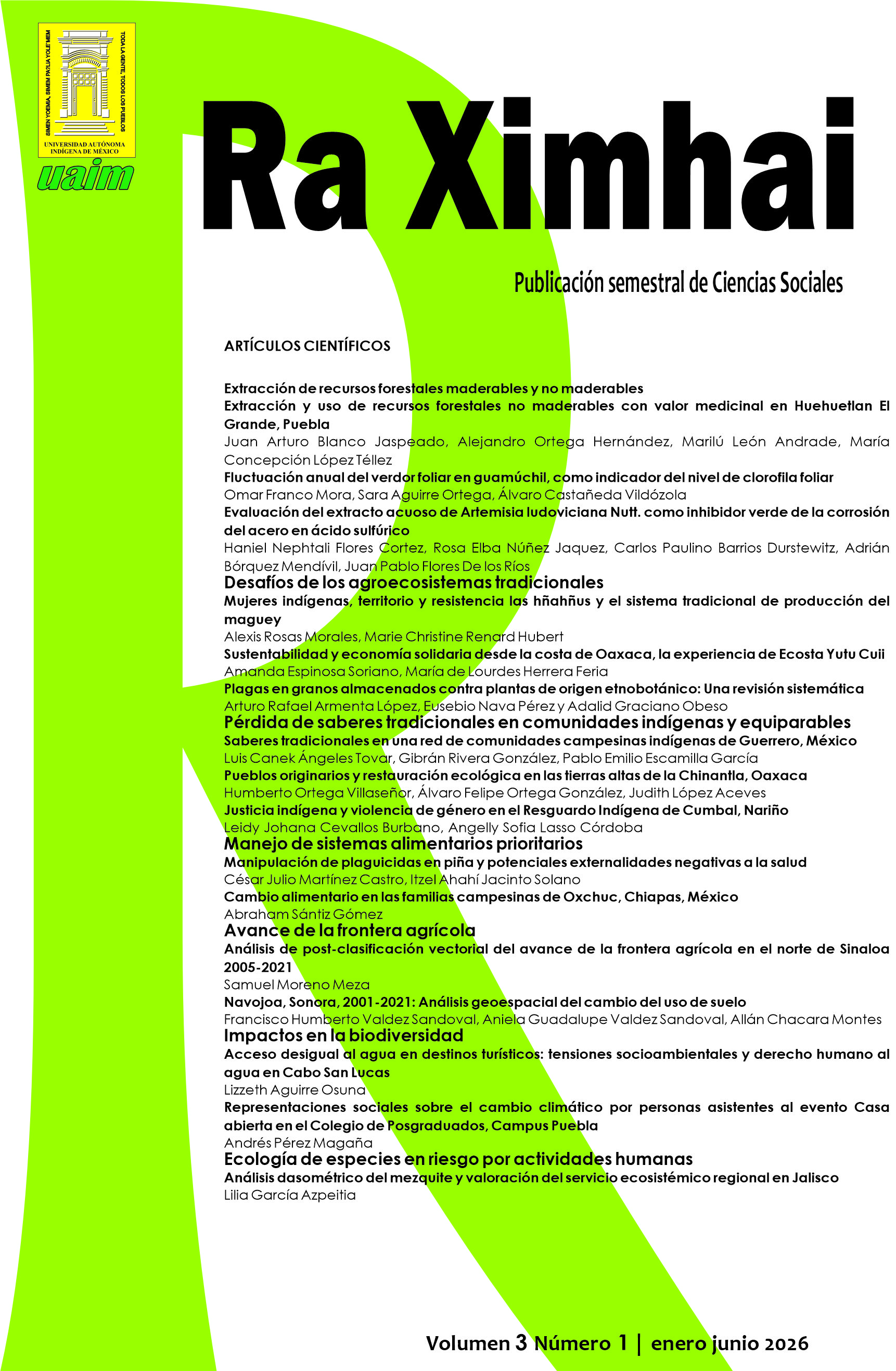
Extraction and use of non-timber forest resources with medicinal value in Huehuetlán el Grande, Puebla
DOI:
https://doi.org/10.35197/rx.22.01.2026.01.jbKeywords:
Ethnobotany, Knowledge exchange, Medicinal plants, Traditional knowledgeAbstract
Indigenous and peasant communities possess ecological, agricultural, and medicinal knowledge that synergistically correlates with their environment in order to meet their needs. The aim of this research is to identify various medicinal plants with medicinal use value within the community of Huehuetlán el Grande, Puebla, Mexico. The study was conducted using a participatory action research approach and incorporated certain formal aspects of ethnobotanical research. Use-report forms were employed during field walks, and 50 surveys were administered to key community actors knowledgeable in the use and collection of medicinal plants. In parallel, semi-structured interviews were conducted and photographs were taken. A total of 69 morphospecies belonging to 41 botanical families with medicinal value were identified; these are used as ingredients in various herbal remedies (in the form of infusions, poultices, etc.). In the case of Huehuetlán el Grande, the ethnobotanical heritage of non-timber forest resources of medicinal nature fulfills the function of fostering cohesion within the community, strengthening the “c factor” or “community factor.” This form of social cohesion contributes to preserving the biocultural richness of the territory. Finally, it was evidenced that, within the collection, management, and use of non-timber forest resources—such as medicinal plants—there exists an underlying solidarity-based economy, which is related to individual well-being and seeks social reproduction through mutual aid.
Downloads
References
Acuña, René. 1985. Relaciones geográficas de Tlaxcala. Vol II. UNAM, 922
Blanco, J. A. (2019). Aplicación de benchmarking en la cadena de comercialización de la planta medicinal zacatechichi (calea zacatechichi schltdl), en la región de Puebla, México. (Vol. 1). Colegio de Postgraduados Campus Puebla.
Boege, E., Encino, P., & Ramírez, G. (2000). Protegiendo lo nuestro Manual para la gestión ambiental comunitaria, uso y conservación de la biodiversidad de los campesinos indígenas de América Latina. In Programa de las Naciones Unidas para el Medio Ambiente. PNUMA.
Bonfil Batalla, G., 1987. México profundo; una civilización negadaGuillermo Bonfil Batalla, Ed. Grijalbo S.A, México DF.
Bravo, M., Arteaga, M. I., & Herrera, F. F. (2017). Bioinventario de especies subutilizadas comestibles y medicinales en el norte de Venezuela. Boletin Latinoamericano y Del Caribe de Plantas Medicinales y Aromaticas, 16(4), 347–360.
Carreño , P. C. (2016). La Etnobotánica y su importancia como herramienta para la articulacion entre conocimientos ancentrales y cientificos. In Monografía, Trabajo De Grado Para Optar Al Titulo Licenciado En Biología.
Castañeda, R. (2014). Comparación de tres índices de significancia cultural de la flora silvestre del caserío de Pisha (Pamparomás, Áncash).
Castro, R. (2000). La Vida en la Adversidad: el Significado de la Salud y la Reproducción en la Pobreza. In CRIM-UNAM.
Diskin, M., Scott, C., & Hope, A. (1975). Mercados de Oaxaca. 8(305), 7–12.
Dougherty, P. M., Whitehead, D., & Vose, J. M. (1994). Environmental influences on the phenology of pines. Ecological Bulletin, 43, 64–75.
Freire, P. (1997). La educación como práctica de la libertad (45th ed.). Siglo XXI editores.
Gobierno de Puebla. (2021). Plan de desarrollo municipal de Huehuetlán el Grande 2021-2024 (pp. 1–67).
Hernández, E. (2007). La investigación de huarache. Revista de Geografía Agrícola, 39, 113–116.
Hernández, E., Vargas, N., & Gómez, T. (1983). Consideraciones etnobotánicas de los mercados de México. Revista de Geografía Agrícola, 4.
Hersch, P., & Fierro, A. (2001). El comercio de plantas medicinales Algunos rasgos significativos En el centro de México. In Plantas, Cultura y Sociedad. Estudio sobre la relación entre seres humanos y plantas en los albores del siglo XXI (pp. 53–75). Universidad Autónoma Metropolitana, Secretaría del Medio Ambiente, Recursos Naturales y Pesca.
Hersh, P., & Chavez, L. G. (1996). Investigacion participativa en etnobotanica, algunos procedimientos coadyuvantes en ella. Dimensión Antropológica, 8, 130–156.
Hirai, S. (2012). “¡Sigue los símbolos del terruño!”: etnografía multilocal y migración transnacional. In M. Ariza & L. Velasco (Eds.), Metodos cualitativos y su aplicación empírica. Por los caminos de la investigación sobre migración internacional (pp. 47–75). El colegio de la frontera norte AC.
Hiscock, P. (1994). Technological responses to risk in Holocene Australia. Journal of World Prehistory, 8, 267–292.
Decreto del Ejecutivo del Estado, por el que declara Área Natural Protegida de Jurisdicción Estatal, en su modalidad de Reserva Estatal, la zona denominada “Sierra del Tetnzo,” de Puebla G. C. D. E. Periódico Oficial (2011).
Ladio, A., & Mariana, L. (2009). Human ecology, ethnobotany and traditional practices in rural populations inhabiting the Monte region: resilience and ecological knowledge. Journal of Arid Environments, 73(2), 222–227.
Marín, L., & Rivera, L. A. (2020). En la puerta de entrada a la Mixteca Poblana : El patrimonio biocultural de los pueblos de la región de Huehuetlan El Grande.
Martin, G. (1977). Etobotánica. Manual de métodos. NORDAN-COMUNIDAD.
Miranda, J., Herrera, B. E., Paredes, J, A., & Delgado, A. (2009). Conocimiento tradicional sobre predictores climáticos en la agricultura de los Llanos de Serdán, Puebla, México. Tropical and Subtropical Agroecosystems, 10(2), 151–160.
Morón, M. Á., Aragón, A., Tapia, A. M., & Rojas, R. (2000). Coleoptera lamellicornia de la Sierra del Tentzo, Puebla, México. Acta Zoológica Mexicana, 9, 77–102.
Muñoz, D. (1591). Historia de Tlaxcala (A. Chavero (ed.)). Secretaría de fomento. http://cdigital.dgb.uanl.mx/la/1080013261/1080013261.PDF
Ochoa, J. J., & Ladio, A. H. (2015). Plantas silvestres con órganos subterráneos comestibles: transmisión cultural sobre recursos subutilizados en la Patagonia (Argentina). Boletin Latinoamericano y Del Caribe de Plantas Medicinales y Aromaticas, 14(4), 287–300.
Ramírez, M. (2020). El manejo forestal comunitario en el municipio de Huehuetlán el Grande, ANP sierra del Tentzo, Puebla. https://repositorioinstitucional.buap.mx/handle/20.500.12371/4639
Rivera, L. (2004). Transformaciones comunitarias y remesas socioculturales de los migrantes mixtecos poblanos. Migración y Desarrollo, 2, 62–81.
Rodríguez, M., Jiménez, A. y James, A. (2010). Plantas de importancia económica en el estado de Puebla (BUAP (Ed.)).
Toscano, J. (2006). Uso tradicional de plantas medicinales en la vereda san isidro, municipio de San José de Pare-Boyacá: un estudio preliminar usando técnicas cuantitativas. Acta Biológica Colombiana, 11(2), 137–146.
Valdés, A. (2013). Conservación y uso de plantas medicinales el caso de la región de la Mixteca Alta Oaxaqueña, México. Ambiente y Desarrollo, 17(33), 87–99.
Zemelman, H. (1989). Crítica epistemológica de los indicadores (El Colegio de México (Ed.); Primera).
Downloads
Published
How to Cite
Issue
Section
License
Copyright (c) 2026 Juan Arturo Blanco Jaspeado, Alejandro, Marilú, Concepción

This work is licensed under a Creative Commons Attribution-NonCommercial 4.0 International License.
Usted es libre de:
- Compartir — copiar y redistribuir el material en cualquier medio o formato
- Adaptar — remezclar, transformar y construir a partir del material
- La licenciante no puede revocar estas libertades en tanto usted siga los términos de la licencia
Bajo los siguientes términos:
- Atribución — Usted debe dar crédito de manera adecuada , brindar un enlace a la licencia, e indicar si se han realizado cambios . Puede hacerlo en cualquier forma razonable, pero no de forma tal que sugiera que usted o su uso tienen el apoyo de la licenciante.
- NoComercial — Usted no puede hacer uso del material con propósitos comerciales .
- No hay restricciones adicionales — No puede aplicar términos legales ni medidas tecnológicas que restrinjan legalmente a otras a hacer cualquier uso permitido por la licencia.