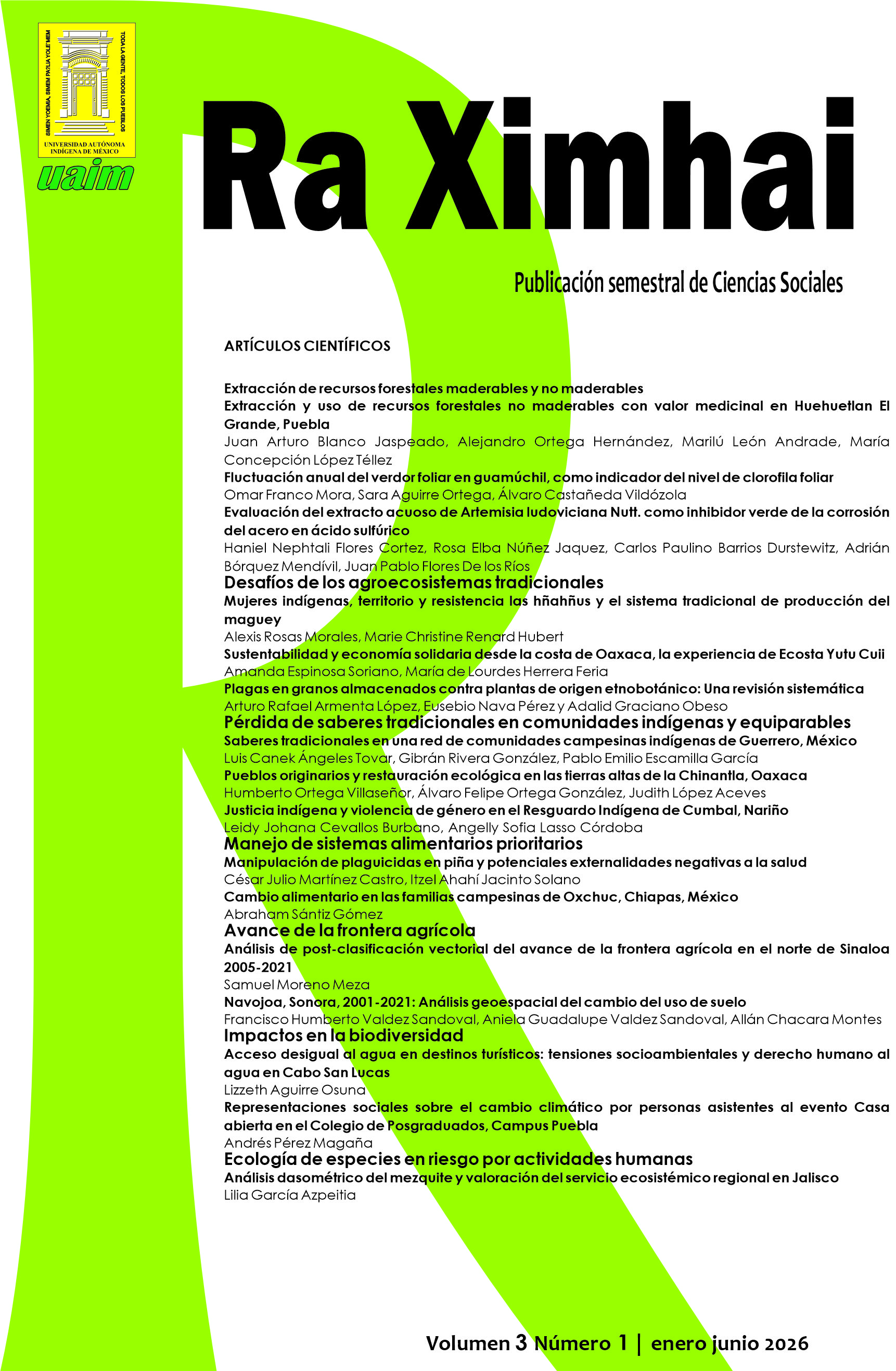
Dendrometric analysis of mesquite and assessment of regional ecosystem service in Jalisco
DOI:
https://doi.org/10.35197/rx.22.01.2026.16.lgKeywords:
Biodiversity, Dendrometry, Ecosystem, Restoration, SustainabilityAbstract
A structural analysis of a native thorn forest located in the state of Jalisco was conducted to characterize the arboreal composition and ecological conditions of the ecosystem, as well as to determine the dendrometric structure of mesquite (Prosopis laevigata (Humb. & Bonpl. ex Willd.) M. C. Johnst.) as the dominant species. The tree stratum was identified, abiotic variables were recorded, and the main anthropogenic activities were evaluated. Statistical analysis, with a 95% confidence level, showed that the tree species had a density of 210 individuals/ha and a relative density (RD) of 71.19%, followed by huizache (Acacia farnesiana (L.) Willd.) with 80 individuals/ha and an RD of 28.81%. Physicochemical alterations were detected in 10% of the soil, human activity impacts were found in 30% of the area, and deforestation equivalent to 10% (40 trees/ha). Natural regeneration was nonexistent for individuals between 0.1 and 1 m in height, indicating a process of progressive degradation. Based on this characterization, the thorn forest was assessed as a regional ecosystem service, considering its environmental, social, and ecological functions. Regulating services (CO₂ sequestration, soil conservation, biomass generation, and thermal mitigation), provisioning services (timber resources and mesquite fruit), supporting services (biodiversity maintenance), and cultural services (regional identity and spiritual value) were identified. The results demonstrate the importance of conserving this ecosystem as a strategic resource for sustainability and biodiversity preservation in the semi-arid regions of Mexico.
Downloads
References
Arias A.D. (2012). Morfometría del árbol en plantaciones forestales tropicales. Revista Forestal Mesoamericana Kurú, 2(5), 19–32. https://revistas.tec.ac.cr/index.php/kuru/article/view/543
Álvarez J.A., Villagra P.E., Villalba R.V., Cony M.A. & Alberto M. (2011). Wood productivity of Prosopis flexuosa D.C. woodlands in the central Monte: Influence of population structure and tree-growth habit. J Arid Env, 75 (1), 7-13. Doi: https://doi.org/10.1016/j.jaridenv.2010.09.003
Antunes, A. C., et al. (2024). Linking biodiversity, ecosystem services, and Nature’s Contributions to People. Trends in Ecology & Evolution, 39(3), 201-213. https://doi.org/10.1016/j.tree.2024.01.002
Bautista Z.F., Palacio P.J.L. & Páez B. R. (2011). Técnicas de muestreo para manejadores de recursos naturales. Centro de Investigación en Geografía Ambiental. México: Universidad Nacional Autónoma de México. Doi: https://doi.org/10.22201/ciga.9786070221279p.2011
Becerril P. R., González S. E., Mastachi L. C. A., Díaz D. C., & Ramos-Salinas, N. M. (2014). Contenido de carbono en un ecosistema semiárido del centro de México. Ecosistemas y recursos agropecuarios, 1(1), 9-18. Doi: https://doi.org/10.19136/era.a1n1.2
Bernal R.L.A., Zavala H.J.A., Jiménez M., Cano S.Z. & Fornoni J. (2019). Los microcosmos de Prosopis laevigata albergan una alta diversidad florística en el valle de Zapotitlán, Puebla. Rev Mex Bio, 90, 1-14. Doi: 10.22201/ib.20078706e.2019.90.2662
Bone G., Parr T., Brameld J., Elmes M., González C. Z. & Koech O. (2021). The effect of mezquite pod flour in a wheat-based diet on broiler chicken growth performance. Animal - Science proceedings, 12 (1), 77. https://doi.org/10.1016/j.anscip.2021.03.099
Bonnesoeur, V., Constant, T., Moulia, B., & Fournier, M. (2016). Forest trees filter chronic wind-signals to acclimate to high winds. New Phytologist, 210(3), 850–860. https://doi.org/10.1111/nph.13836
Comisión Nacional Forestal, SIRE-Paquetes Tecnológicos. (2017). Prosopis laevigata (Humb. et Bonpl. ex Willd). http://www.conafor.gob.mx:8080/documentos/docs/13/988Prosopis%20laevigata.pdf
CONAFOR (2020a). Estimación de la tasa de deforestación en México para el periodo 2001-2018 mediante el método de muestreo. Documento Técnico. Jalisco, México. Consejo Nacional Forestal. Deforestación en México. Disponible en: https://www.gob.mx/conafor/documentos/estimacion-de-la-tasa-dedeforestacion-bruta-en-mexico-para-el-periodo-2001-2018-mediante-el-metodo-demuestreo?idiom=es
CONAFOR. (2020b). Sector Forestal Mexicano en cifras 2020: Bosques para el bienestar social y climático. Gobierno de México. Comisión Nacional Forestal
CONAFOR (2024). Deforestación en México. Consejo Nacional Forestal. Secretaría del Medio Ambiente y Recursos Naturales. https://snmf.cnf.gob.mx/deforestacion/
Comisión Nacional del Agua. (2024). Actualización de la disponibilidad media anual de agua en el acuífero Lagos de Moreno (1410), estado de Jalisco. Ciudad de México, México.
Chen, H., Zhao, X., & Zhang, T. (2024). Valuation and management of desert ecosystems and their services. Ecosystem Services, 66, 102117. https://doi.org/10.1016/j.ecoser.2024.102117
Foroughbakhch Pournavab, M. Ngangyo Heya, E. A. Castillo Gonzalez, A. Rocha Estrada, L. R. Salas Cruz & M. A. Alvarado Vázquez. (2024). Leaf architecture in the morphological diversity of the genus Prosopis in the semi-desert area of northeastern Mexico. Diversity, 16(6), 351. https://doi.org/10.3390/d16060351
Flores P.A., García F.J.G., Capistrán B.A. (2015). Biomass, phorophyte specificity and distribution of Tillandsia recurvata in a tropical semi-desert environment (Chihuahuan Desert, Mexico). Plant Ecol and Evol, 148 (1), 68-75. Doi: http://dx.dol.org/10.5091/plecevo.2015.874
Fontana, M., Pérez V., Luna C. 2018. Efecto del origen geográfico en la calidad morfológica de plantas de Prosopis alba (Fabaceae). Rev Biol, 66 (2), 593-604. Doi: http://dx.dol.org/10.15517/rbt.v66i2.33383
González Rodríguez, H., Dueñas Tijerina, H. A., Cantú Silva, I., Cotera Correa, M., Ramírez Lozano, R. G., & López Hernández, J. M. (2018). Relaciones hídricas en arbustos nativos del noreste de México. Revista Mexicana de Ciencias Forestales, 9(50). https://doi.org/10.29298/rmcf.v9i50.229
Guarneros-Manoatl, H., Valtierra-Pacheco, E., & Corona-Sánchez, J. E. (2024). Neltuma laevigata and its inf luence on soil fertility in the Valle del Mezquital, Hidalgo, Mexico. Agro Productividad. https://doi.org/10.32854/agrop.v17i11.2987
Gunderson, L. H., & Holling, C. S. (Eds.). (2002). Panarchy: Understanding transformations in human and natural systems. Island Press.
Haines-Young, R., & Potschin, M. (2018). Common International Classification of Ecosystem Services (CICES) V5.1: Guidance on the application of the revised structure. Fabis Consulting Ltd.
Hedblom, M., Gunnarsson, B., Iravani, Knez I., Schaefer M., Thorsson P. & Lundström J.N. (2019). Reduction of physiological stress by urban green space in a multisensory virtual experiment. Sci Rep, 9, 10113. https://doi.org/10.1038/s41598-019-46099-7
IIEG. Diagnóstico del municipio de Lagos de Moreno [monografía en internet]*. Jalisco: Instituto de Información Estadística y Geográfica. (2024, junio 2025). https://www.iieg.gob.mx/contenido/Municipios/LagosdeMoreno.pdf.
IMMA. Índice Municipal de Medio Ambiente [archivo en formato XLS]*. México: Gobierno federal; (2016, junio 2025). https://datos.gob.mx/busca/dataset/indice-municipal-de-medio-ambiente.
IIEG-INEGI. Instituto de Información Estadística y Geográfica (Jalisco) (2018). Análisis del cambio de uso de suelo y vegetación en Jalisco (2011-2014). Carta de Uso de Suelo y Vegetación Serie VI, Jalisco, uso de suelo, vegetación. https://iieg.gob.mx/strategos/
Instituto Nacional de Estadística y Geografía (INEGI). (2017). Conjunto de datos vectoriales de uso del suelo y vegetación. Serie VI. INEGI. https://www.inegi.org.mx/temas/usosuelo/
Janeczko, E., Bieninis E., Wojcik, R., Woznicka, M., Kędziora, W., Łukowski, A., Elsadek, M., Szyc, K. & Janeczko, K. (2020). Cuando el entorno urbano es restaurador: el efecto de caminar en los suburbios y los bosques en la relajación psicológica y fisiológica de los adultos jóvenes polacos. Bosques,11 , 591. https://doi.org/10.3390/f11050591
Jiao-jun, Z. (2004). Review: Effects of wind on trees. Journal of Forestry Research, 15, 153–160. https://doi.org/10.1007/BF02857836
Lee S.G., Felker P. (1992). Influence of water/heat stress on flowering and fruiting of mesquite (Prosopis glandulosa var. glandulosa). J Arid Env, 23, 309-319. Doi: http://dx.dol.org/10.1016/S0140-1963(18)30521-4
Cámara de Diputados del H. Congreso de la Unión. (2003). Ley General de Desarrollo Forestal Sustentable. Diario Oficial de la Federación (México), 25 de febrero de 2003. https://www.diputados.gob.mx/LeyesBiblio/pdf/LGDFS.pdf
Martínez-Garza, C., Ceccon, E., & Méndez-Toribio, M. (2022). Ecological and social limitations for Mexican dry forest restoration: A systematic review. Sustainability, 14(7), 3793. https://doi.org/10.3390/su14073793
Méndez G.J. Turlan M.O.A, Rios S.J.C. & Najera L.J.A. (2012). Allometric equations to estimate aerial biomass of Prosopis laevigata (Humb. & Bonpl. ex Willd.) M.C. Johnst. Rev mex cienc forestales, 3 (13), 1-16. https://www.scielo.org.mx/scielo.php?pid=S2007-11322012000500006&script=sci_abstract&tlng=en
Méndez E.R., Romo L.J.R. & Castellanos A.E. (2017). Mapping Changes in Carbon Storage and Productivity Services Provided by Riparian Ecosystems of Semi-Arid Environments in Northwestern Mexico. ISPRS International Journal of Geo-Information. 6 (10), 298. https://doi.org/10.3390/ijgi10110720
Mesa-Sierra, N., de la Peña-Domene, M., Campo, J., & Giardina, C. P. (2022). Restoring Mexican tropical dry forests: A national review. Sustainability, 14(7), 3937. https://doi.org/10.3390/su14073937
Morfín, R.J.E., Michel F.M.J., González M.R., Carrillo O., Mayorga R., Rangel L., Orozco O.J., Rodríguez A.G. & Guerrero P.G. (2015). Estimación de las reservas de carbono en la biosfera forestal en México. Fortalecimiento de la preparación REDD en México y fomento de la cooperación Sur-Sur. Jalisco: CONAFOR México, 116-121. http://www.conafor.gob.mx:8080/documentos/docs/35/6917Anexo%208.pdf
Morin, P. J. (2011). Community ecology (2nd ed.). Wiley-Blackwell.
Morales-Gallegos, L. M., Martínez-Trinidad, T., Hernández-de la Rosa, P., Gómez-Guerrero, A., Alvarado-Rosales, D., & Saavedra-Romero, L. de L. (2023). Tree health condition in urban green areas assessed through crown indicators and vegetation indices. Forests, 14(8), 1673. https://doi.org/10.3390/f14081673
Moreno-Contreras, M. G., Herrera Flores, T. S., Licea De Anda, E. M., Arratia Castro, A. A., & Medina Haro, A. (2021). Diversidad morfológica del mezquite (Prosopis spp.) en la región de Pénjamo, Guanajuato, México. Entreciencias: Diálogos En La Sociedad Del Conocimiento, 9(23). https://doi.org/10.22201/enesl.20078064e.2021.23.7786
Muñoz Iniestra, D. J., [coautores]. (2017). Cambios edáficos en islas de fertilidad y su importancia en el funcionamiento de un ecosistema del valle de Tehuacán, Puebla, México. Terra Latinoamericana.
Navar, J., Rodríguez-Flores FdJ, Ríos-Saucedo J. (2019). Biomass estimation equations for mesquite trees (Prosopis spp.) in the Americas. PeerJ, 7, e6782. https://doi.org/10.7717/peerj.6782
Nelson, H. P., Rivera, J. A., & López, M. R. (2020). A review of tropical dry forest ecosystem service research in the Caribbean. Ecosystem Services, 45, 101157. https://doi.org/10.1016/j.ecoser.2020.101157
Pasiecznik, N.M., Felker P., Harris P.J.C., Harsh L.N., Cruz G., Tewari J.C., Cadoret K. & Maldonado L.J. (2001). The Prosopis juliflora - Prosopis pallida Complex: A Monograph; Forest Ecology and Management, 174 (1),172. Doi: http://dx.dol.org/10.1016/S0378-1127(02)00559-5.
Palacios R.A., Rodríguez L.R., Hernández F.M.L., Jiménez M.E. & Tirado T.D. (2016). Distribución potencial de Prosopis laevigata (Humb. Et Bonpl. Ex Willd) M.C. Johnston basada en un modelo de nicho ecológico. Rev mex cienc forestales, 7 (34), 35-46. DOI: https://doi.org/10.29298/rmcf.v7i34.81
Pérez N.F.J. (2015). Tillandsia recurvata como parásita estructural de Prosopis laevigata: Evidencia experimental en el sur del Desierto Chihuahuense [Tesis de Maestría Departamento de Ciencias Ambientales, Instituto Potosino de Investigación Científica y Tecnológica]. http://hdl.handle.net/11627/4037
Pérez-Noyola, F. J., Flores, J., Yáñez-Espinosa, L., & otros. (2021). Is ball moss (Tillandsia recurvata) a structural parasite of mesquite (Prosopis laevigata)? Anatomical and ecophysiological evidence. Trees, 35, 135–144. https://doi.org/10.1007/s00468-020-02023-
Pérez D, Cabirol N., Martínez C.C. & Rojas O. M. (2021). Mesquite management in the Mezquital Valley: A sustainability assessment based on the view point of the Hñähñú indigenous community. Environmental and Sustainability Indicators, 10 (100113), 1-12. https://doi.org/10.1016/j.indic.2021.100113
Prasad A.R., Maraseni T., Geoff C. (2019). Global trend of forest ecosystem services valuation – An analysis of publications. Ecosystem Services, 39, 100979. https://doi.org/10.1016/j.ecoser.2019.100979
Pretzsch, H. (2021). Tree–tree interactions, spatial structure, and neighborhood dynamics in mixed-species forests. Forest Ecology and Management, 482, 118849. https://doi.org/10.1016/j.foreco.2020.118849
Qiu, J., Chen, D., & Balvanera, P. (2024). Ecosystem service linkages in real landscapes: Mapping biodiversity–function–benefit relationships. Landscape Ecology, 39(5), 1123-1139. https://doi.org/10.1007/s10980-024-01872-9
Ramírez M.R., Delgado B.E., Borodanenko A., Pérez M.L., Barrera G.J.L., Nuñez P.H.G. & Ochoa A.N. (2014). Air Layering and Tiny-Air Layering Techniques for Mesquite [Prosopis laevigata (H. B. ex Willd.) Johnst. M. C.] Tree Propagation. Arid Land Research and Management, 28,118–128. https://doi.org/10.1080/15324982.2013.813609
Ren, Y., Li, X., & Xu, G. (2023). Spatial and temporal effects on the value of ecosystem services in arid and semi-arid areas. Frontiers in Ecology and Evolution, 11, 1122334. https://doi.org/10.3389/fevo.2023.1122334
Rodríguez S.N. E., Rojo M.G.E., Ramírez V.B., Martínez R.R., Cong H.M.C., Medina T.S.M. & Piña R.H.H. (2014). Análisis técnico del árbol de mezquite (Prosopis laevigata Humb. & Bonpl. Ex Willd.) en México. Ra Ximhai, 10 (3), 173-193. DOI: https://doi.org/10.35197/rx.10.01.e.2014.13.er
Rodríguez-Solís, M., Briceño-Elizondo, E., Gamboa-Zúñiga, J. P., & Arias-Aguilar, D. (2015). Biomass assessment, volume equations and crown architecture of Eucalyptus pellita F. Muell in a commercial plantation in Mexico. Revista Forestal Mesoamericana Kurú, 12(29), 46–52. https://doi.org/10.18845/rfmk.v12i29.2254
Roy H. Y., Marion P. C. (2017). International Classification of Ecosystem Services (CICES) V5.1Guidance on the Application of the Revised Structure by Fabis Consulting Ltd. The Paddocks, Chestnut Lane, Barton in Fabis, Nottingham, NG11 0AE, UK. https://seea.un.org/sites/seea.un.org/files/lg23_cices_v5.1_final_revised_guidance_03-10-2017.pdf. https://cices.eu/
Salas-Aguilar, V., Carrillo-Anzures, F., & González-Montero, G. (2021). Application of a Bayesian approach to adjust biomass allometric equations: Context Mexico. Scientia Forestalis, 49(130), e3682. https://doi.org/10.18671/scifor.v49n130.13
Saavedra R.L.L., Alvarado R.D., Martínez T.T. & Hernández R.P. (2019). Identification of defects and risks in trees of San Juan de Aragon Forest, Mexico City. Rev Chapingo Serie Cienc Forestales Amb. 25 (1), 31- 47. Doi: http://dx.dol.org/10.5154/r.rchscfa.2018.06.049
Sánchez Reyes U. J., Niño-Maldonado S., Barrientos- Lozano L., Treviño- Carreón J, Almaguer- Sierra P. (2019). Seasonal microclimatic Variation in a seccession gradient of low thorn forest in Northeastern Mexico. Revista de Biología Tropical, 67 (1), 266-277.
Soto-Correa, J. C., Cambrón-Sandoval, V. H., & Renaud-Rangel, R. (2019). Atributos de las especies arbóreas y su carbono almacenado en la vegetación del municipio de Querétaro, México. Madera y Bosques, 25(1), e2511699
Valenzuela N.L.M., Ríos S.J.C., Barrientos A.K.R., Muro P.G., Sánchez S.J. & Briceño C.E.A. (2015). Estructura y composición florística en dos comunidades de mezquite (Prosopis laevigata (Humb. & Bonpl. Ex Willd.) M. C. Johnst.) en Durango, México. Interc., 40 (7), 465-472. https://www.redalyc.org/articulo.oa?id=33940000005
Valverde T. & Bernal R. (2010). Hay asincronía demográfica entre poblaciones locales de Tillandsia recurvata? Evidencias de su funcionamiento metapoblacional. Bol Soc Bot Mex, 86, 23-36.https://www.scielo.org.mx/scielo.php?script=sci_abstract&pid=S0366-21282010000100003&lng=en&nrm=iso&tlng=es
Wang, H., Schurgers, G., Rademacher, T. T., & Smith, M. J. (2022). Stronger wind, smaller tree: Testing tree growth plasticity through a modeling approach. Frontiers in Plant Science, 13, 971690. https://doi.org/10.3389/fpls.2022.971690
Weather Atlas. (2025) (s. f.). Anual y mensual del tiempo – Lagos de Moreno, México. Recuperado el [17 sep 2025], de https://www.weather-atlas.com/es/mexico/lagos-de-moreno-clima
Yuan, M., Yin, C., Sun, Y., & Chen, W. (2019). Examining the associations between urban built environment and noise pollution in high-density high-rise urban areas: A case study in Wuhan, China. Sustainable Cities and Society, 50, 101678. https://doi.org/10.1016/j.scs.2019.101678
Zarate VJL. (2018). Estudio regional forestal de la UMAFOR Laguna. Rev Chapingo Serie Cienc Fores Amb, 25 (1), 31- 47. Doi: http://dx.dol.org/10.5154/r.rchscfa.06.049
Downloads
Published
How to Cite
Issue
Section
License
Copyright (c) 2026 Lilia García Azpeitia

This work is licensed under a Creative Commons Attribution-NonCommercial 4.0 International License.
Usted es libre de:
- Compartir — copiar y redistribuir el material en cualquier medio o formato
- Adaptar — remezclar, transformar y construir a partir del material
- La licenciante no puede revocar estas libertades en tanto usted siga los términos de la licencia
Bajo los siguientes términos:
- Atribución — Usted debe dar crédito de manera adecuada , brindar un enlace a la licencia, e indicar si se han realizado cambios . Puede hacerlo en cualquier forma razonable, pero no de forma tal que sugiera que usted o su uso tienen el apoyo de la licenciante.
- NoComercial — Usted no puede hacer uso del material con propósitos comerciales .
- No hay restricciones adicionales — No puede aplicar términos legales ni medidas tecnológicas que restrinjan legalmente a otras a hacer cualquier uso permitido por la licencia.