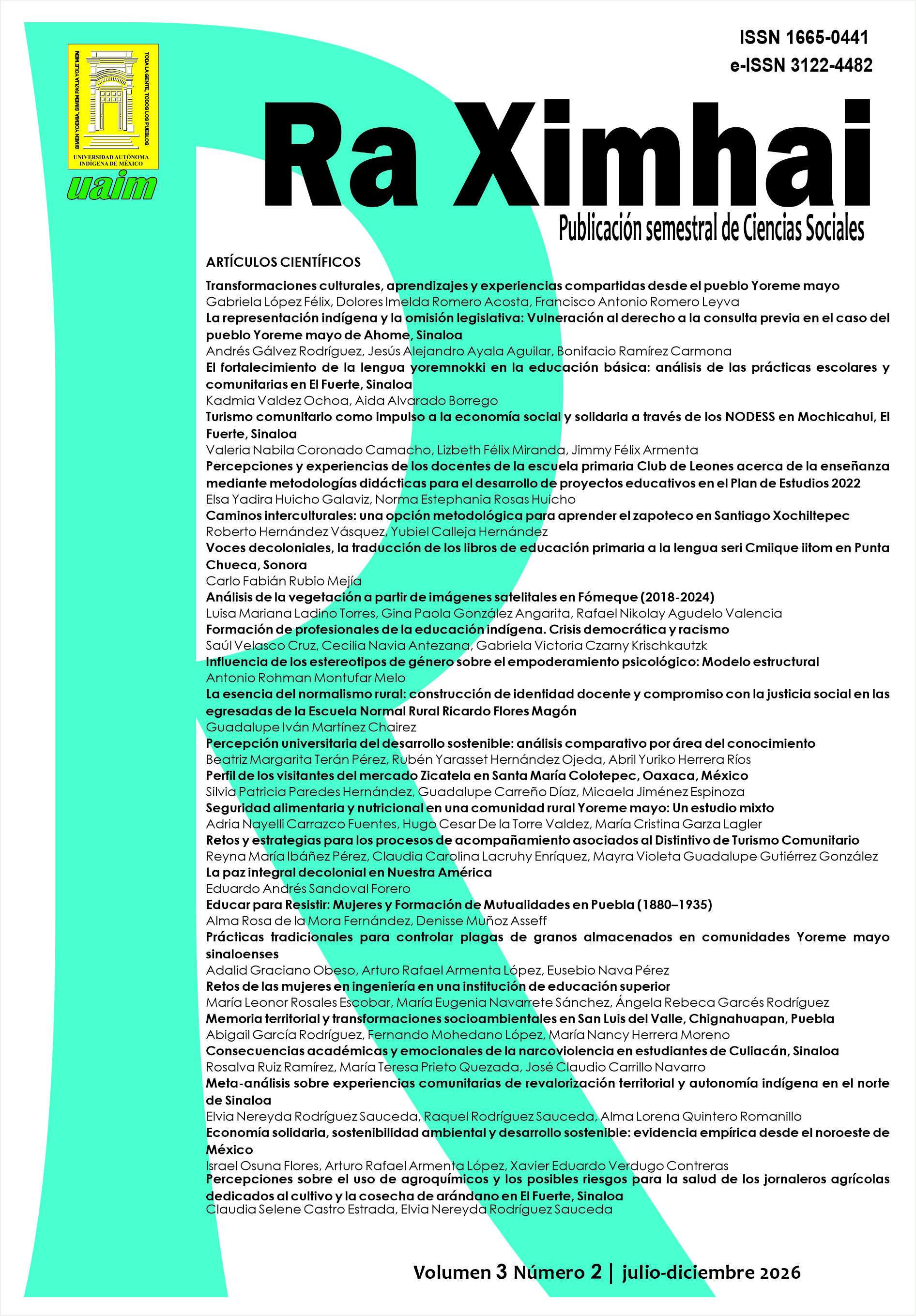
Strengthening the Yoremnokki language in basic education: an analysis of school and community practices in El Fuerte, Sinaloa
DOI:
https://doi.org/10.35197/rx.22.02.2026.03.kvKeywords:
Yoremnokki language, secondary school, indigenous languages, linguistic strengthening, inclusive educationAbstract
The strengthening of indigenous languages in education requires strategies that integrate both school-based and community practices. This article presents an initial thesis research that analyzes the revitalization of the Yoremnokki language in basic education, with emphasis on the secondary level, in the municipality of El Fuerte, Sinaloa. The objective is to identify and analyze educational and community practices that influence the presence and use of the Yoremnokki language in schools. Through a qualitative methodology, the perceptions of teachers, students, and community members were explored. Findings indicate that while some elementary schools offer limited spaces for the native language, its presence in secondary education is almost nonexistent. Family and community practices were identified as key elements in language strengthening, provided there are joint strategies between schools and communities. This paper contributes to building educational models that promote linguistic continuity and inclusive, culturally relevant education.
Downloads
References
Cámara, G., López, E., & Sánchez, A. (2004). Comunidad de aprendizaje: cómo hacer de la educación básica un bien valioso y compartido. Consejo Nacional de Fomento Educativo (CONAFE).
Flecha, R. (2015). Aprendizaje dialógico: una propuesta pedagógica para la transformación social. Paidós.
Freire, P. (1992). Pedagogía del oprimido (17.ª ed.). Siglo XXI Editores.
García, Y., & Puigvert, L. (2018). Comunidades de aprendizaje: una experiencia innovadora de transformación social y educativa. Revista Latinoamericana de Estudios Educativos, 48(1), 9–27.
Guerra García, E., Soto Izaguirre, J. H., Real Audeves, J. R., & Apodaca Félix, A. L. (2020). La educación indígena en Sinaloa. Ediciones del Lirio.
Grosfoguel, R. (2022). Decolonizando los saberes, repensando las universidades. CLACSO.
Instituto Nacional de Lenguas Indígenas (2023). Catálogo de las lenguas indígenas nacionales. https://www.inali.gob.mx
Schmelkes del Valle, S. (2022). Urbes de México, sin educación intercultural-bilingüe para indígenas. Universidad Iberoamericana.
Secretaría de Educación Pública (2022). Plan de estudios para la educación preescolar, primaria y secundaria. Nueva Escuela Mexicana. Gobierno de México. https://nuevaescuelamexicana.sep.gob.mx
Solís, R., & Alcántara, M. (2023). Lenguas originarias en riesgo: una lectura desde la sociolingüística crítica. Revista de Educación Intercultural, 12(2), 45–61.
Valdez López, M. R. (2024). El papel de la mujer Yoreme en un contexto intercultural. Centro ceremonial de “La Purísima Concepción” de Charay y poblaciones que lo componen [Tesis de maestría inédita, Universidad Autónoma Indígena de México].
Vargas Macías, S. (2024). La inclusión en la nueva escuela mexicana: un análisis documental. Formación Estratégica, 8(2).
Walsh, C. (2005). Interculturalidad, conocimiento y de(s)colonialidad. Revista Polis, (10), 1–17.
Walsh, C. (2014). Interculturalidad crítica y educación intercultural. En C. Walsh (Comp.), Educación y justicia social (pp. 85–112). Siglo del Hombre Editores / CLACSO.
Downloads
Published
How to Cite
Issue
Section
License
Copyright (c) 2026 Kadmia Valdez Ochoa, Aida Alvarado Borrego

This work is licensed under a Creative Commons Attribution-NonCommercial 4.0 International License.
Usted es libre de:
- Compartir — copiar y redistribuir el material en cualquier medio o formato
- Adaptar — remezclar, transformar y construir a partir del material
- La licenciante no puede revocar estas libertades en tanto usted siga los términos de la licencia
Bajo los siguientes términos:
- Atribución — Usted debe dar crédito de manera adecuada , brindar un enlace a la licencia, e indicar si se han realizado cambios . Puede hacerlo en cualquier forma razonable, pero no de forma tal que sugiera que usted o su uso tienen el apoyo de la licenciante.
- NoComercial — Usted no puede hacer uso del material con propósitos comerciales .
- No hay restricciones adicionales — No puede aplicar términos legales ni medidas tecnológicas que restrinjan legalmente a otras a hacer cualquier uso permitido por la licencia.