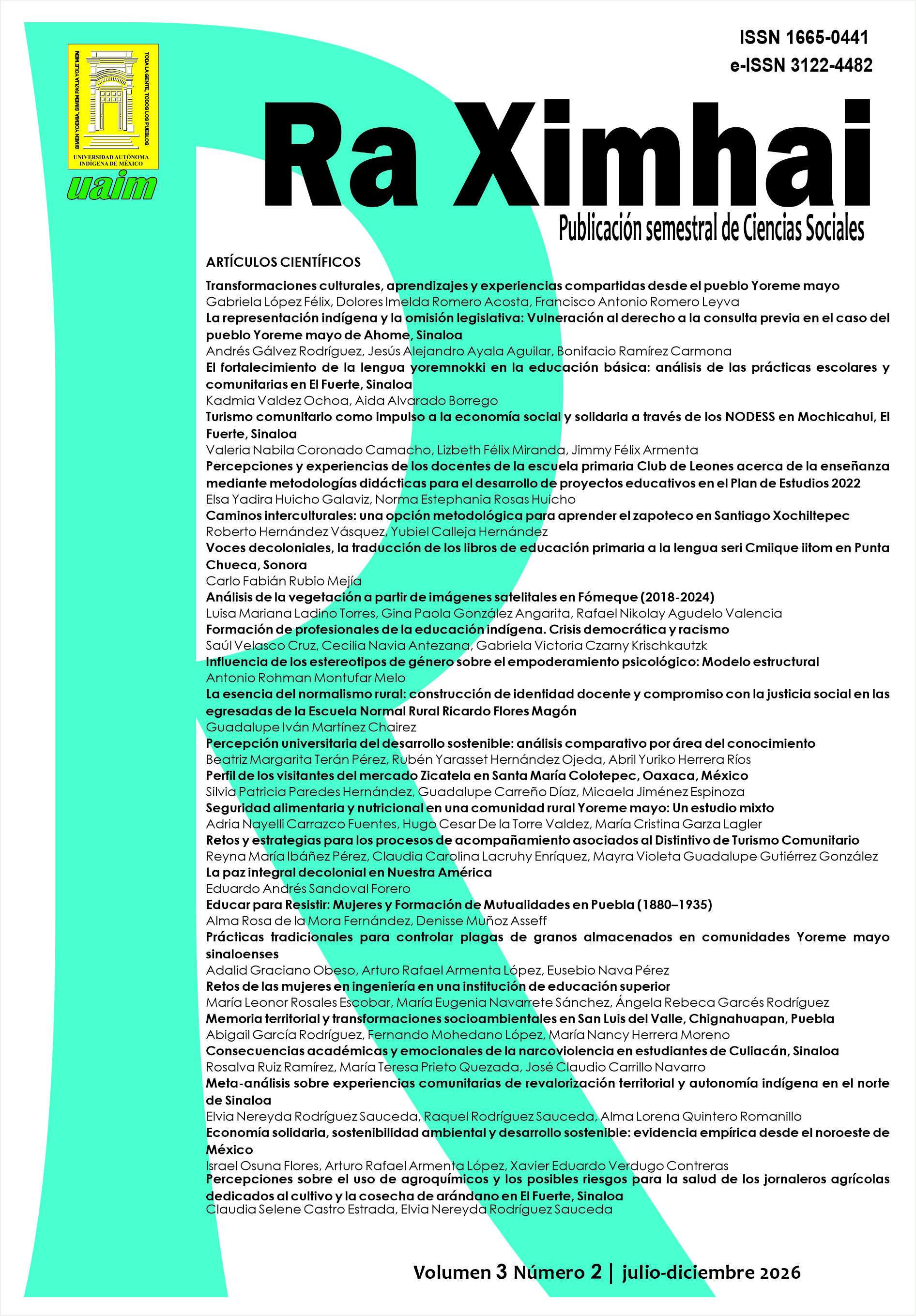
Meta-analysis on community experiences of territorial revaluation and indigenous autonomy in northern Sinaloa
DOI:
https://doi.org/10.35197/rx.22.02.2026.22.erKeywords:
indigenous autonomy, territorial revaluation, community meta-analysisAbstract
This article presents a meta-analysis of community experiences in the municipalities of Choix and El Fuerte, Sinaloa, focused on the revaluation of territory, indigenous autonomy, and food sovereignty. Fifty case studies and secondary sources from 2010 to 2024 were systematized. Through comparative matrices, thematic coding, and impact indicator analysis, common success elements were identified, such as community organization, the recovery of traditional knowledge, and technical-cultural support. The study confirms that territorial initiatives with an intercultural approach generate sustainable impacts when grounded in identity, local participation, and a long-term vision.
Downloads
References
Acosta, A. (2012). El Buen Vivir: Sumak Kawsay, una oportunidad para imaginar otros mundos. Icaria Editorial.
Altieri, M. A. (2009). Agroecology, small farms, and food sovereignty. Monthly Review, 61(3), 102–113.
Barabas, A. M. (2008). Autonomía y territorio en el México indígena: una aproximación etnográfica. CIESAS.
Bardin, L. (2002). Análisis de contenido. Ediciones Akal.
Barrera-Bassols, N., & Toledo, V. M. (2005). Ethnoecology of the Yucatec Maya: Symbolism, knowledge and management of natural resources. Journal of Latin American Geography, 4(1), 9–41.
Bebbington, A. (2007). Social capital and development studies II: Can Bourdieu travel to policy? Progress in Development Studies, 7(2), 155–162.
Berger, R. (2015). Now I see it, now I don’t: Researcher’s position and reflexivity in qualitative research. Qualitative Research, 15(2), 219–234.
Borenstein, M., Hedges, L. V., Higgins, J. P. T., & Rothstein, H. R. (2009). Introduction to Meta‑Analysis. Wiley.
Charmaz, K. (2006). Constructing Grounded Theory. Sage.
Cohen, J. (1960). A coefficient of agreement for nominal scales. Educational and Psychological Measurement, 20(1), 37–46.
CONEVAL e INEGI. (2020–2024). Mediciones multidimensionales de pobreza y desigualdad. Consejo Nacional de Evaluación de la Política de Desarrollo Social.
Cornwall, A., & Jewkes, R. (1995). What is participatory research? Social Science & Medicine, 41(12), 1667–1676.
Creswell, J. W., & Poth, C. N. (2018). Qualitative inquiry and research design: Choosing among five approaches (4th ed.). SAGE Publications.
Denzin, N. K., & Lincoln, Y. S. (Eds.). (2018). The SAGE Handbook of Qualitative Research (5th ed.). SAGE Publications.
DerSimonian, R., & Laird, N. (1986). Meta‑analysis in clinical trials. Controlled Clinical Trials, 7(3), 177–188.
Dietz, G., & Mateos Cortés, L. S. (2011). Multiculturalismo, interculturalidad y educación en América Latina: Tensiones y perspectivas. Revista Iberoamericana de Educación, 55(2), 1–16.
Duval, S., & Tweedie, R. (2000). A nonparametric “trim and fill” method of accounting for publication bias in meta-analysis. Journal of the American Statistical Association, 95(449), 89–98.
Duval, S., & Tweedie, R. (2000). Trim and fill: A simple funnel‑plot–based method. Biometrics, 56(2), 455–463.
Egger, M., Davey Smith, G., Schneider, M., & Minder, C. (1997). Bias in meta-analysis detected by a simple, graphical test. BMJ, 315(7109), 629–634.
Escobar, A. (2008). Territories of difference: Place, movements, life, networks. Duke University Press.
Escobar, A. (2010). Territorios de diferencia: lugar, movimientos, vida, redes. Universidad Autónoma de la Ciudad de México.
Escobar, A. (2010). Una minga para el postdesarrollo: Lugar, medio ambiente y movimientos sociales en América Latina. Universidad Andina Simón Bolívar/Abya Yala.
Gliessman, S. R. (2014). Agroecology: The ecology of sustainable food systems (3rd ed.). CRC Press.
Gudynas, E. (2011). Buen Vivir: Germinando alternativas al desarrollo. América Latina en Movimiento, 462, 1–20.
Gurevitch, J., Koricheva, J., Nakagawa, S., & Stewart, G. (2018). Meta-analysis and the science of research synthesis. Nature, 555(7695), 175–182.
Hernández Castillo, R. A. (2016). Mujeres indígenas y autonomía: Género, territorio y poder. México: CIESAS.
Higgins, J. P. T., & Green, S. (Eds.). (2011). Cochrane handbook for systematic reviews of interventions (Version 5.1.0). The Cochrane Collaboration.
Higgins, J. P. T., & Thompson, S. G. (2002). Quantifying heterogeneity in a meta-analysis. Statistics in Medicine, 21(11), 1539–1558.
Higgins, J. P. T., Thomas, J., Chandler, J., Cumpston, M., Li, T., Page, M. J., & Welch, V. A. (Eds.). (2019). Cochrane handbook for systematic reviews of interventions (2nd ed.). Wiley.
Ioannidis, J. P. A. (2005). Why most published research findings are false. PLoS Medicine, 2(8), e124.
Kimmerer, R. W. (2013). Braiding sweetgrass: Indigenous wisdom, scientific knowledge, and the teachings of plants. Milkweed Editions.
Krippendorff, K. (2018). Content analysis: An introduction to its methodology (4th ed.). SAGE Publications.
Leff, E. (2004). Racionalidad ambiental: La reapropiación social de la naturaleza. Siglo XXI Editores.
Lincoln, Y. S., & Guba, E. G. (1985). Naturalistic inquiry. SAGE Publications.
Lockwood, C., Munn, Z., & Porritt, K. (2015). Qualitative research synthesis: Methodological guidance for systematic reviewers. JBI Database of Systematic Reviews, 13(10), 1–9.
Martínez Luna, J. (2013). Eso que llaman comunalidad. Consejo Nacional para la Cultura y las Artes.
Martínez Luna, J. (2014). Comunalidad, autonomía y buen vivir. Ediciones del Lirio.
Ostrom, E. (1990). Governing the commons: The evolution of institutions for collective action. Cambridge University Press.
Paez, A. (2017). Gray literature: An important resource in systematic reviews. Journal of Evidence‑Based Medicine, 10(3), 233–240.
Page, M. J., et al. (2021). The PRISMA 2020 statement. BMJ, 372, n71.
Patton, M. Q. (2015). Qualitative research & evaluation methods (4th ed.). SAGE Publications.
Restrepo, E., & Rojas, A. (2010). Inflexión decolonial en la teoría social latinoamericana. Ediciones desde abajo.
Santos, B. de S. (2009). Una epistemología del sur: la reinvención del conocimiento y la emancipación social. CLACSO.
Scheyvens, R. (1999). Ecotourism and the empowerment of local communities. Tourism Management, 20(2), 245–249.
Shrier, I., & Platt, R. W. (2008). Reducing bias through directed acyclic graphs. BMC Medical Research Methodology, 8(1), 70.
Stephen, L. (2005). Women’s rights are human rights: Campaigns and concepts in the Mexican women’s movement. Gender & History, 17(2), 370–392.
Sterne, J. A. C., Hernán, M. A., Reeves, B. C., Savović, J., Berkman, N. D., Viswanathan, M., & Higgins, J. P. T. (2016). ROBINS-I: A tool for assessing risk of bias in non-randomised studies of interventions. BMJ, 355, i4919.
Thomas, J., & Harden, A. (2008). Methods for the thematic synthesis of qualitative research. BMC Medical Research Methodology, 8, 45
Toledo, V. M. (2009). La memoria biocultural: la importancia ecológica de las sabidurías tradicionales. Icaria Editorial.
Toledo, V. M. (2020). El México profundo: Una civilización negada. Editorial Ítaca.
Downloads
Published
How to Cite
Issue
Section
License
Copyright (c) 2026 Elvia Nereyda Rodríguez Sauceda, Raquel Rodríguez Sauceda, Alma Lorena Quintero Romanillo

This work is licensed under a Creative Commons Attribution-NonCommercial 4.0 International License.
Usted es libre de:
- Compartir — copiar y redistribuir el material en cualquier medio o formato
- Adaptar — remezclar, transformar y construir a partir del material
- La licenciante no puede revocar estas libertades en tanto usted siga los términos de la licencia
Bajo los siguientes términos:
- Atribución — Usted debe dar crédito de manera adecuada , brindar un enlace a la licencia, e indicar si se han realizado cambios . Puede hacerlo en cualquier forma razonable, pero no de forma tal que sugiera que usted o su uso tienen el apoyo de la licenciante.
- NoComercial — Usted no puede hacer uso del material con propósitos comerciales .
- No hay restricciones adicionales — No puede aplicar términos legales ni medidas tecnológicas que restrinjan legalmente a otras a hacer cualquier uso permitido por la licencia.